 https://twitter.com/home https://www.facebook.com/Shabbir.Hussain191
By Shabbir Hussain
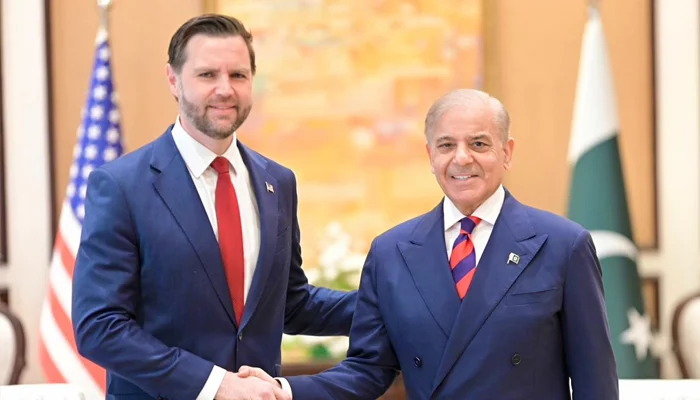
ISLAMABAD, April 11 (Alliance News): Prime Minister Shehbaz Sharif on Saturday met US Vice President JD Vance as the much-anticipated US-Iran talks formally began in Islamabad, raising hopes for lasting peace in the Middle East.
The US vice president was accompanied by Special Envoy Steve Witkoff and senior adviser Jared Kushner. The prime minister was joined by Deputy Prime Minister and Foreign Minister Ishaq Dar and Interior Minister Mohsin Naqvi.
Welcoming both delegations, Prime Minister Shehbaz Sharif appreciated their willingness to engage in dialogue and expressed hope that the Islamabad talks would serve as a stepping stone toward sustainable peace in the region. He reaffirmed Pakistan’s commitment to facilitating constructive engagement between the United States and Iran.
The meeting took place shortly after the arrival of the US delegation in Islamabad earlier in the day. A high-level Iranian delegation, led by Parliament Speaker Mohammad Baqer Qalibaf, is also participating in the talks, along with Foreign Minister Abbas Araghchi.
The negotiations follow a two-week ceasefire announced by US President Donald Trump after weeks of intense conflict involving US and Israeli strikes on Iran. Despite the ceasefire, tensions remain high, particularly over the strategic Strait of Hormuz and ongoing clashes involving Israel and Iran-backed groups in the region.
Ahead of the talks, Qalibaf reiterated Iran’s position, stressing that Washington must honour prior commitments, including easing restrictions on Iranian assets and ensuring a ceasefire in Lebanon. He warned that without progress on these issues, negotiations could face difficulties.
Vice President Vance expressed cautious optimism, stating that the United States is ready for constructive engagement but would respond firmly to any attempt to undermine the process.
The conflict, which began on February 28, has resulted in significant casualties and widespread instability across the region. Although a ceasefire was reached on April 8 with Pakistan playing a key mediating role, several critical issues remain unresolved.
At the centre of the talks are major disagreements over Iran’s nuclear programme, economic sanctions, regional influence, and control of the Strait of Hormuz. The United States has proposed a 15-point framework focusing on nuclear restrictions, sanctions relief, and free navigation, while Iran has presented a 10-point plan seeking sanctions removal, recognition of its nuclear rights, and greater control over the strategic waterway.
Diplomatic sources say both sides are willing to engage, but differences remain significant. The outcome of the Islamabad talks is being closely watched by the international community, as it could shape the future of regional stability and global security.