ISLAMABAD, Jun 24 (Alliance News): Prime Minister Muhammad Shehbaz Sharif on Tuesday clarified that Iran’s ballistic missile programme was not part of the Islamabad Memorandum of Understanding (MoU) signed between Tehran and Washington, emphasizing that the issue was never discussed during negotiations aimed at ending the Middle East conflict.
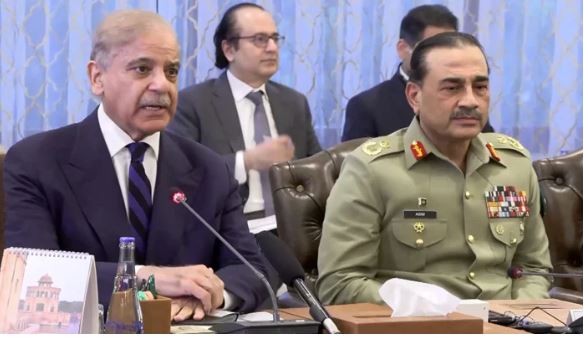
Addressing a delegation-level meeting alongside Iranian President Masoud Pezeshkian in Islamabad, the prime minister said there should be no confusion regarding the contents of the agreement and warned against attempts by “spoilers” to misrepresent the understanding and undermine the peace process.
Prime Minister Shehbaz said the MoU does not contain any reference to ballistic missiles, adding that the matter was not on the negotiating agenda between Iran and the United States.
He questioned what he described as “double standards” regarding missile capabilities, saying Iran, like other countries, had the right to maintain its defence capabilities.
“In my capacity as a mediator, I can say with full confidence that ballistic missiles are not mentioned in the MoU in any form,” the prime minister said, urging observers to avoid misinterpretation of the agreement.
He reaffirmed that Pakistan would continue its mediation efforts between Iran and the United States until a lasting and honourable peace was achieved.
The prime minister appreciated the resilience of the Iranian leadership and people during recent challenges and praised the contribution of Chief of Defence Forces and Chief of Army Staff Field Marshal Syed Asim Munir in supporting efforts that led to the ceasefire and the signing of the Islamabad MoU.
He also acknowledged the support of regional partners, including Qatar, Saudi Arabia, Turkiye, and Egypt, saying their cooperation contributed to progress in the diplomatic process.
Prime Minister Shehbaz warned that any wider conflict could have serious consequences for the region and beyond, stressing that Pakistan would continue working to prevent escalation and promote dialogue.
Following the talks, Prime Minister Shehbaz Sharif and President Masoud Pezeshkian addressed a joint press conference, where both leaders reiterated their commitment to strengthening Pakistan-Iran relations, regional stability, and continued cooperation.
The prime minister described his discussions with the Iranian president as highly productive and said Pakistan valued Iran’s trust in Islamabad’s role as a facilitator of peace talks.
He said Pakistan and Iran shared close historical, cultural, and brotherly relations, adding that any success for Iran was a success for Pakistan and any challenge faced by Tehran would also concern Islamabad.
President Pezeshkian also clarified that Iran’s missile programme was not included in the Islamabad MoU and “will never be” part of such an agreement.
He said Iran would not negotiate its defence capabilities with any country, while emphasizing that regional peace and stability could only be achieved through sincere dialogue and cooperation among regional states.
The Iranian president praised Pakistan’s mediation efforts and said the signing of the Islamabad MoU reflected Tehran’s confidence in Islamabad’s diplomatic role.
He described Pakistan as not only a neighbouring country but also a brotherly nation with deep historical, cultural, and religious connections.
President Pezeshkian expressed confidence that relations between Pakistan and Iran would continue to expand in political, economic, and regional areas.
He thanked the government and people of Pakistan for their support and appreciated Islamabad’s efforts for peace, development, and prosperity in the region.
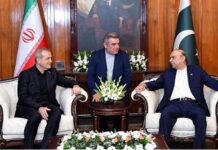
During his visit, President Pezeshkian also held meetings with President Asif Ali Zardari and Chief of Defence Forces Field Marshal Syed Asim Munir, where discussions focused on bilateral relations, regional developments, and security cooperation.
The Iranian president arrived in Islamabad earlier in the day on a special aircraft operated by Mirage Airlines, identified as Minab 168, as part of his first foreign visit after the recent escalation involving Iran.
He received a red carpet welcome and guard of honour upon arrival, with Prime Minister Shehbaz Sharif, President Asif Ali Zardari, senior government officials, and Iranian Foreign Minister Abbas Araghchi attending the reception.
President Pezeshkian later concluded his official visit and departed for Tehran. Field Marshal Syed Asim Munir and Deputy Prime Minister and Foreign Minister Senator Ishaq Dar saw him off at the airport.