 https://twitter.com/home https://www.facebook.com/Shabbir.Hussain191
By Shabbir Hussain
ISLAMABAD, Dec 24 (Alliance News): A post-COP30 panel discussion held in Islamabad on Tuesday stressed the urgent need to translate global climate commitments into practical national policies and grassroots action, with experts warning that delays and weak coordination could cost Pakistan heavily in the coming years.
The event, jointly organised by the Climate Action Forum (CAF), IRM, and the Institute of Regional Studies (IRS), brought together more than 100 participants from government departments, academia, students and civil society organisations.
The discussion aimed to unpack the outcomes of COP30 and examine how international climate decisions can be meaningfully applied in Pakistan’s local context.
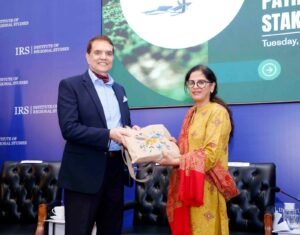
Ms. Khalida Bashir, Joint Secretary of the Climate Finance Wing at the Ministry of Climate Change and Environmental Coordination, attended the event as the chief guest.
In her opening remarks, she highlighted Pakistan’s growing engagement in global climate processes and underlined the importance of strengthening national systems to access and effectively use international climate finance.
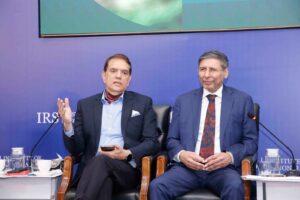
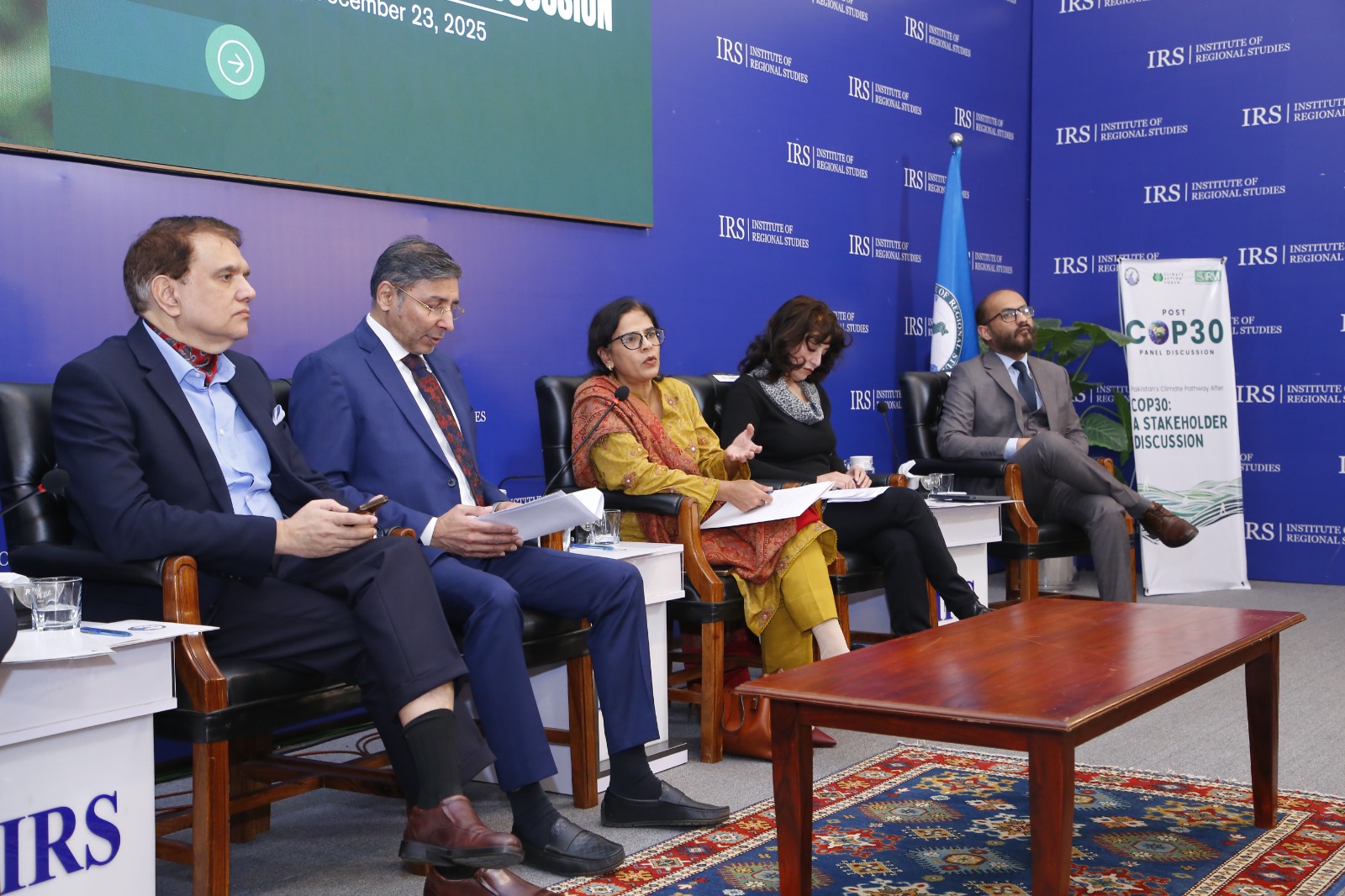
The panel included Dr. Roomi S. Hayat, Chair of the Climate Action Forum and Chief Executive Officer of IRM; Ms. Aisha Khan, Chief Executive Officer of the Civil Society Coalition for Climate Change (CSCCC); Mr. Arif Goheer, Executive Director of the Global Change Impact Studies Centre (GCISC); and Dr. Khalid Waleed, Research Fellow at the Sustainable Development Policy Institute (SDPI). Ambassador Jauhar Saleem, President of the Institute of Regional Studies, moderated the discussion.
The speakers shared diverse and in-depth views on the outcomes of COP30, with a strong emphasis on Pakistan’s responsibilities and opportunities after the global climate summit.
The discussion focused on climate finance, national coordination, the progress of Pakistan’s climate commitments, and the need for inclusive and collective approaches to climate action.
Responding to a question on the loss and damage fund, Ms. Khalida Bashir said the government was actively working on ideas to leverage this important financing mechanism.
She explained that the National Disaster Risk Management Fund (NDRMF) and the National Disaster Management Authority (NDMA) were already engaged in related efforts, while the Ministry of Climate Change was seeking stronger support from provincial governments.
She noted that institutional capacity needed to be strengthened at both federal and provincial levels to ensure that funds from international sources could be channelled effectively and transparently.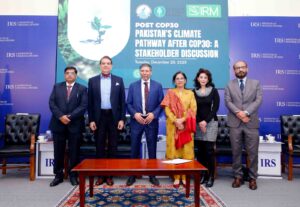
According to her, better coordination between institutions would help Pakistan respond more efficiently to climate-induced disasters such as floods, heatwaves and droughts.
Dr. Roomi S. Hayat highlighted the coordination challenges that often slow down climate action in Pakistan.
He said one of the key weaknesses was the limited integration of scientific research, technical data and indigenous knowledge in policymaking and implementation.
“What limits our ability to respond to climate shocks and take effective climate action is the lack of integration between science, technical expertise and local knowledge,” he said.
He also pointed out that civil society organisations were often engaged too late in the process, usually as implementers rather than partners in planning and design.
This late engagement, he argued, reduces efficiency and weakens the overall impact of climate initiatives. He called for stronger multi-stakeholder platforms where government institutions, researchers, and civil society could work together from the outset.
Speaking on Pakistan’s progress on its climate commitments, Mr. Arif Goheer referred to the country’s Nationally Determined Contributions (NDCs) under the Paris Agreement.
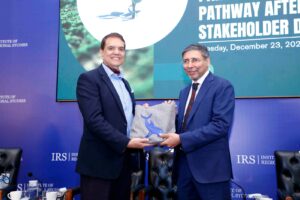
He acknowledged that the last two NDC submissions had been delayed by about a year but said efforts were made this time to meet the deadline.
“This time, we tried our best to meet the 2025 deadline and submitted the NDCs right on time before COP30,” he said.
He added that timely submission was important not only for international credibility but also for aligning national development planning with climate goals.
Ms. Aisha Khan focused her remarks on the gap between global promises and action on the ground. She stressed that the challenge facing Pakistan was not a lack of commitments or resources, but the failure to translate these commitments into real protection for vulnerable communities.
“We do not have limited resources for climate action. What we need is to turn promises into protection on the ground for communities that are hardest hit by climate change,” she said.
She warned that if this gap remained unaddressed, Pakistan would pay a very heavy price in terms of human suffering and economic losses.
She also emphasised the role of civil society in ensuring accountability and in bridging the gap between policymakers and affected communities, particularly women, children and marginalised groups.
Dr. Khalid Waleed added an important dimension to the discussion by referring to the concept of Just Transition and the Belem Political Package adopted at COP30. He explained that the Belem Package was built around the idea of “Mutirão,” a term meaning collective action.
“This idea of collective action is very important at a time when multilateralism is weakening and trust in global processes is eroding,” he said. He noted that despite its limitations, the COP process remains one of the few global platforms where local problems can be discussed in a global context.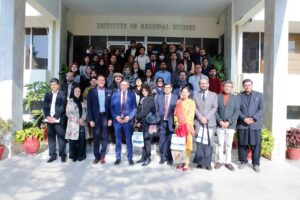
In Pakistan’s case, he argued, an “institutional Mutirão” was needed, where different institutions work collectively rather than in silos. Such an approach, he said, could help align climate policies, economic planning and social protection measures.
Throughout the session, speakers repeatedly stressed the importance of post-COP dialogues.
They noted that many policymakers, practitioners and communities are not directly involved in COP negotiations, making it difficult for them to fully understand the implications of global agreements.
Forums like the Islamabad panel, they said, play a critical role in breaking down complex international outcomes, encouraging informed debate and ensuring that global decisions are owned and followed up at the national and local levels.
The discussion concluded with a shared view that Pakistan stands at a crucial moment in its climate journey. While international recognition of climate vulnerability and access to finance are improving, the real test lies in implementation, coordination and inclusion.
Participants agreed that sustained dialogue, strong institutions and collective action across government, academia and civil society would be essential if Pakistan is to turn post-COP30 momentum into lasting climate resilience and sustainable development.