 https://twitter.com/home https://www.facebook.com/Shabbir.Hussain191
By Shabbir Hussain
ISLAMABAD, June 9 (Alliance News): Pakistan and China on Tuesday reaffirmed their unwavering commitment to deepening bilateral cooperation, advancing high-quality development under the China-Pakistan Economic Corridor (CPEC), and promoting a more inclusive and equitable international order during a high-level seminar marking the 75th anniversary of diplomatic relations between the two countries.
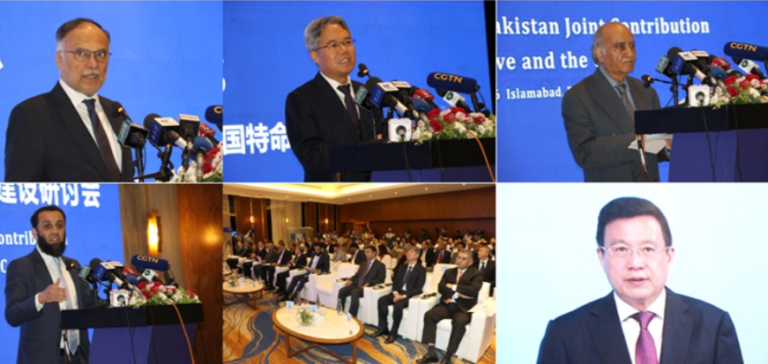
The commemorative seminar, titled “75 Years of Friendship: China-Pakistan Joint Contributions to the Global Governance Initiative and CPEC,” was organized by the Institute of Strategic Studies Islamabad (ISSI) in collaboration with the Xinhua News Agency.
The event brought together federal ministers, diplomats, scholars, policy experts, media representatives, and development practitioners from Pakistan and China to celebrate the enduring friendship between the two nations and explore future avenues of cooperation.
The seminar served as a reflection on the remarkable journey of Pakistan-China relations over the past seven and a half decades, highlighting the achievements of their all-weather strategic cooperative partnership and its growing significance in regional and global affairs.
In a special video message, President of Xinhua News Agency, Fu Hua, extended warm congratulations to the governments and peoples of Pakistan and China on the historic milestone of 75 years of diplomatic relations.
He emphasized that the friendship between the two countries has stood the test of time and changing international circumstances, evolving into a model of interstate relations based on mutual respect, trust, solidarity, and shared interests.
Fu Hua noted that Pakistan and China have consistently supported one another on issues of core national interest, demonstrating a level of strategic trust that has become an example for the international community.
He stressed that the Global Governance Initiative (GGI), proposed by Chinese President Xi Jinping, seeks to promote fairness, inclusiveness, and equality in global governance structures while advocating cooperation over confrontation and mutual benefit over zero-sum competition.
He described CPEC as a practical embodiment of the principles underpinning the Global Governance Initiative, pointing to its achievements in infrastructure development, transportation networks, energy cooperation, industrial growth, and regional connectivity.
He further underscored the vital role of media institutions and think tanks in strengthening mutual understanding, enhancing public awareness, and fostering people-to-people contacts between Pakistan and China.
Welcoming the participants, Chairman Board of Governors ISSI, Ambassador Khalid Mahmood, highlighted the exceptional nature of Pakistan-China relations, describing them as a strategic partnership rooted in sovereign equality, mutual trust, and unwavering support for each other’s fundamental interests.
He stated that over the decades, the bilateral relationship has emerged as a key pillar of regional peace, stability, and economic development.
Referring to CPEC as the flagship project of China’s Belt and Road Initiative (BRI), Ambassador Khalid Mahmood said the corridor has already made transformative contributions to Pakistan’s energy sector, transportation infrastructure, and national connectivity.
He observed that the next phase of CPEC would focus on broader socio-economic development through industrial cooperation, agricultural modernization, Special Economic Zones (SEZs), technological innovation, environmental sustainability, and people-centered growth initiatives.
According to him, these efforts will help create employment opportunities, enhance productivity, and contribute to long-term economic prosperity.
Delivering the keynote address as Chief Guest, Federal Minister for Planning, Development and Special Initiatives Ahsan Iqbal described Pakistan-China relations as one of the most successful and enduring strategic partnerships in modern international relations.
He stated that the relationship has always been characterized by mutual respect, trust, and support during challenging times. He noted that China has consistently stood by Pakistan’s side in its development journey and has played a crucial role in supporting major infrastructure and economic initiatives.
Highlighting the importance of CPEC, the minister termed it the most visible symbol of Pakistan-China friendship and one of the most significant development projects in Pakistan’s history.
He said that CPEC has helped address critical energy shortages, modernize transport infrastructure, improve regional connectivity, and stimulate economic activity across various sectors.
Ahsan Iqbal outlined the priorities of CPEC Phase-II, explaining that the next stage of cooperation would be guided by five strategic corridors: Growth, Livelihood, Innovation, Green Development, and Opening-Up and Regional Connectivity.
He stressed the need to ensure that economic growth translates into tangible benefits for ordinary citizens through employment generation, technological advancement, industrialization, and improved public services.
The minister further emphasized the importance of strengthening regional integration and leveraging Pakistan’s geostrategic location to promote trade, investment, and connectivity among neighboring countries.
Federal Minister for Information and Broadcasting Attaullah Tarar also addressed the gathering and highlighted the significance of media cooperation in strengthening bilateral ties.
He noted that constructive media engagement can play an important role in countering misinformation, promoting positive narratives, and enhancing understanding between the peoples of Pakistan and China.
Chinese Ambassador to Pakistan Jiang Zaidong, in his keynote address, described the 75th anniversary of diplomatic relations as a landmark achievement reflecting the strength and resilience of bilateral ties.
He highlighted the extensive high-level exchanges between the leadership of both countries and noted that strategic trust continues to deepen across political, economic, cultural, and diplomatic spheres.
According to the ambassador, the Pakistan-China partnership remains a shining example of friendly relations built on mutual respect and shared aspirations for development and peace.
Ambassador Jiang reaffirmed that CPEC remains the central pillar of Belt and Road cooperation between Pakistan and China. He noted that the corridor has generated substantial achievements in infrastructure development, energy production, industrial investment, and job creation, significantly contributing to Pakistan’s economic progress.
He further stated that CPEC is evolving into a high-quality development framework that increasingly focuses on agriculture, industrial cooperation, mining, science and technology, environmental sustainability, and livelihood-oriented projects.
These initiatives, he said, will help improve the lives of local communities while supporting sustainable and inclusive economic growth.
The Chinese envoy also reiterated Beijing’s commitment to multilateralism, sovereign equality, respect for international law, and a rules-based international order.
He emphasized that both Pakistan and China share common perspectives on global governance issues and will continue working together to advocate fairness and inclusiveness in international affairs.
A notable feature of the seminar was the presentation of the book “China’s Governance under Xi Jinping’s Leadership (English Edition),” which provides insights into China’s governance model, development philosophy, and policy approaches under President Xi Jinping. Participants viewed the publication as a valuable resource for understanding China’s development experience and its relevance to global governance discussions.
The seminar’s first thematic session, chaired by former Ambassador of Pakistan to China Naghmana Hashmi, focused on Pakistan-China cooperation in advancing the Global Governance Initiative and implementing CPEC Phase-II.
Speakers examined the changing dynamics of global politics and emphasized the growing need for inclusive, equitable, and effective governance mechanisms capable of addressing contemporary challenges such as economic inequality, climate change, technological transformation, and geopolitical instability.
The discussion highlighted the role of CPEC in translating the principles of inclusive governance into practical outcomes through infrastructure connectivity, industrial cooperation, technological innovation, green development, and social welfare initiatives.
Participants stressed that future cooperation should prioritize human development by expanding educational opportunities, vocational training programs, entrepreneurship support, and small and medium enterprise (SME) growth.
Experts also emphasized the importance of policy coordination, knowledge sharing, and positive media narratives in strengthening bilateral cooperation and ensuring broader public understanding of CPEC’s long-term benefits.
The second thematic session, chaired by Tang Binhui, Head of Xinhua News Agency’s Islamabad Bureau, focused on “Pakistan-China Young Talents’ CPEC Story Sharing.”
The session showcased the human dimension of Pakistan-China cooperation and highlighted how CPEC has created opportunities for educational exchange, professional development, and cultural interaction between young people from both countries.
Participants shared personal experiences of working on infrastructure and energy projects, engaging in academic collaborations, and benefiting from professional training opportunities under various China-Pakistan initiatives.
They emphasized that beyond its economic significance, CPEC serves as a bridge connecting communities, fostering mutual trust, promoting cultural understanding, and strengthening people-to-people bonds.
Speakers noted that youth engagement will remain essential for sustaining the momentum of bilateral relations and ensuring that future generations continue to build upon the strong foundations established by the leadership of both countries.
The seminar concluded with a strong reaffirmation of the enduring friendship between Pakistan and China and a shared commitment to advancing high-quality development, strengthening regional connectivity, and supporting an inclusive international order.
Participants expressed confidence that the continued evolution of CPEC, coupled with deeper cooperation under global governance initiatives, would further strengthen the all-weather strategic cooperative partnership and contribute significantly to regional peace, stability, sustainable development, and shared prosperity.