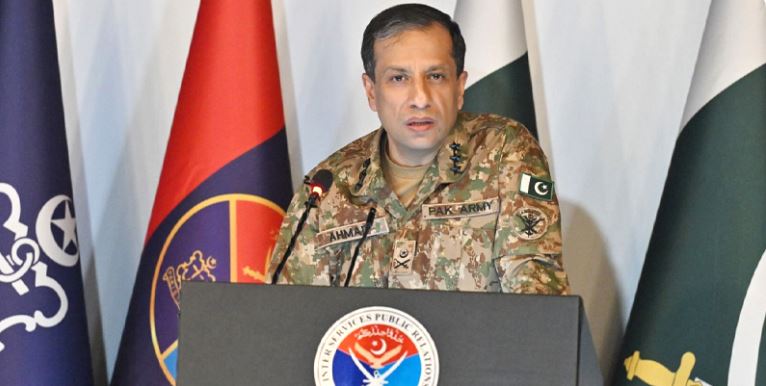
RAWALPINDI, July 31 (Alliance News): Director General Inter-Services Public Relations (DG ISPR) Lieutenant General Ahmed Sharif Chaudhry on Friday ruled out dialogue with terrorists, saying they must surrender to the state under the law or face action.
Addressing a press conference in Rawalpindi, he said terrorists had realised that no leniency would be shown to them. “They must surrender according to the law or we will fight them,” he said.
The DG ISPR said attempts were being made to portray Balochistan as unstable, alleging that certain elements were involved in creating unrest in the province.
He said security forces had conducted 40,348 intelligence-based operations (IBOs) against terrorism across Pakistan over the past five years, killing 2,084 terrorists. Of these, 31,080 operations were conducted in Balochistan, 7,177 in Khyber Pakhtunkhwa and 2,091 in other parts of the country.
He said 178 people had been killed, 55 abducted and 24 bridges destroyed in terrorism-related incidents in Balochistan, while police and Levies personnel had faced 105 attacks.
According to the DG ISPR, 303 army personnel and 322 civilians have been killed in the fight against terrorism so far in 2026.
He said Pakistan witnessed 28 bombing incidents during 2026, alleging that Afghan nationals were involved in most of them, including incidents in Tank and Karachi.
Lieutenant General Ahmed Sharif Chaudhry accused the Afghan Taliban regime of allowing terrorism to operate as a business and said Pakistani forces were targeting militant networks and their alleged handlers.
Discussing Balochistan, the DG ISPR said the province’s challenges were not solely security-related, alleging that some tribal elites and influential groups were contributing to the status quo.
He alleged that some groups were involved in drug and diesel smuggling and sought control over public resources and Levies personnel for private interests.
He stressed that the people of Balochistan were the province’s real stakeholders and that all affairs should be conducted under the Constitution and law.
On the concept of a “hard state”, he said it did not mean military rule but a state where the Constitution and law were implemented equally for everyone. He cited Article 5 of the Constitution, which requires loyalty to the state.
Responding to a question about Interior Minister Mohsin Naqvi’s remarks on creating new provinces or administrative units, the DG ISPR said it was the minister’s personal opinion and declined to comment on it.
However, he stressed that good governance was essential for Pakistan’s stability and security. He questioned why the 14-point National Action Plan, signed by all major political parties, was not being fully implemented.
He said the plan also covered narcotics, smuggling, Afghan refugees, madrassa registration and other governance-related issues.
The DG ISPR said Pakistan’s population had increased significantly while the country still had four provinces. He said any decision regarding new provinces or administrative units should ultimately be made by the people.
On Kashmir, Lieutenant General Ahmed Sharif Chaudhry reiterated Pakistan’s position that Kashmir remains central to the country’s national policy.
He rejected allegations that the Pakistan Army was an occupying force in Azad Jammu and Kashmir, pointing out that many Kashmiris serve in the Pakistani armed forces and that Pakistani soldiers and officers had also sacrificed their lives in connection with Kashmir.
He said Pakistan’s security and governance challenges must be addressed through the Constitution, rule of law, effective governance and implementation of the National Action Plan.