 https://twitter.com/home https://www.facebook.com/Shabbir.Hussain191
By Shabbir Hussain
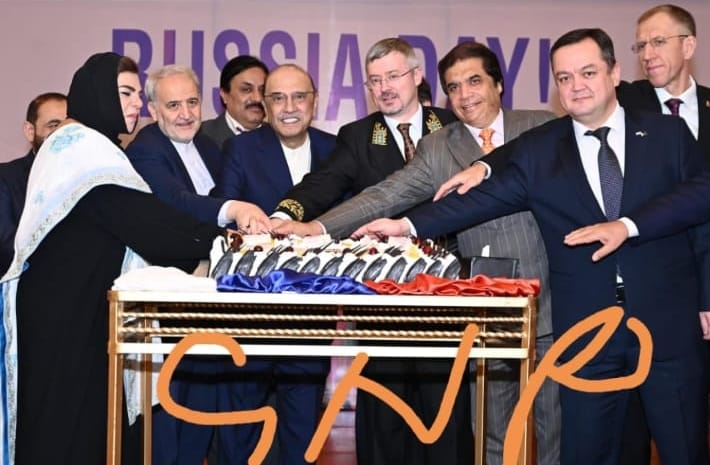
ISLAMABAD, June 11 (Alliance News): Russia has reaffirmed its commitment to a fair and multipolar world order while highlighting the steady growth of its strategic partnership with Pakistan across political, economic, security, cultural and educational sectors, Russian Ambassador to Pakistan Albert P. Khorev said during a ceremony marking Russia Day in Islamabad.
Addressing diplomats, government officials, academics, media representatives and members of the Russian community, Ambassador Khorev underscored the importance of international cooperation based on mutual respect, sovereignty and equality among nations.
He also emphasized Russia’s commitment to preserving cultural diversity and promoting harmony among its many ethnic communities.
The ambassador noted that Russia is home to a vast array of ethnic groups and nationalities that coexist peacefully while enjoying equal rights under the country’s constitution.
He said representatives of all nationalities in Russia have the freedom to use their native languages, receive education in their mother tongues, practise their faiths and preserve their cultural traditions without discrimination.
To symbolize the country’s multicultural identity and interethnic harmony, members of the Russian Embassy staff presented traditional costumes representing various ethnic communities from across the Russian Federation.
The colorful display highlighted Russia’s cultural richness and diversity, reflecting what Khorev described as a successful model of coexistence among different peoples and traditions.
Turning to international affairs, the ambassador reiterated Moscow’s support for a multipolar global order based on the principles of state sovereignty, non-interference in internal affairs and the right of peoples to determine their own political future. He argued that the existing international system requires reforms to better reflect emerging realities and the growing role of developing nations in global governance.
Khorev highlighted Russia’s Greater Eurasian Partnership initiative as an important framework for promoting economic integration, connectivity and cooperation across the Eurasian continent.
The initiative seeks to establish a broad partnership stretching from the Atlantic Ocean to the Pacific and from the Arctic region to the Indian Ocean.
According to the ambassador, the concept is attracting increasing interest among countries of the Global South, many of which are seeking new opportunities for trade, investment, infrastructure development and technological cooperation outside traditional geopolitical blocs.
He said the Greater Eurasian Partnership aims to create equal and mutually beneficial cooperation among participating countries while respecting their sovereignty and national interests. The initiative, he added, complements broader efforts to promote inclusive development and strengthen economic resilience in an increasingly interconnected world.
The ambassador also criticized Western powers, accusing them of resisting changes in the global balance of power and attempting to maintain their dominance in international affairs.
He argued that such policies have contributed to instability and violent conflicts in different parts of the world.
Referring to the ongoing conflict in Ukraine, Khorev defended Russia’s military campaign, describing it as a measure aimed at protecting Russian-speaking populations and safeguarding Russia’s national security interests.
He maintained that Russia remains committed to pursuing a peaceful settlement and is open to negotiations that address what Moscow considers the root causes of the conflict.
The ambassador expressed appreciation for Pakistan’s position on the Ukraine issue, describing Islamabad’s approach as balanced and neutral. He said Russia values Pakistan’s independent foreign policy and its efforts to maintain constructive engagement with all parties amid complex international challenges.
Focusing on bilateral relations, Khorev said ties between Russia and Pakistan have witnessed steady progress in recent years, with cooperation expanding across multiple sectors.
He noted that the two countries have strengthened political dialogue, enhanced parliamentary exchanges and established several institutional mechanisms to facilitate regular consultations.
According to the ambassador, high-level contacts between political leaders and government officials have helped create momentum for deeper engagement. Parliamentary diplomacy has also gained importance as lawmakers from both countries continue to exchange visits and explore areas of mutual cooperation.
Khorev pointed out that four consultation mechanisms are currently operational between the foreign ministries of Russia and Pakistan, providing a structured platform for discussing bilateral, regional and international issues of common interest.
Security cooperation, he said, remains an important pillar of the relationship. He highlighted regular military-to-military contacts and joint exercises as evidence of growing trust between the two countries.
Among the most notable examples are the joint military exercise “Druzhba” and the naval exercise “Arabian Monsoon,” which have contributed to strengthening professional cooperation between the armed forces of both nations.
The ambassador also referred to recent agreements signed between the interior ministries of Russia and Pakistan, aimed at enhancing collaboration in law enforcement and security-related matters.
He particularly welcomed the recently concluded Readmission Agreement, which he said would strengthen cooperation in combating illegal migration, extremism and transnational crime.
The agreement is also expected to facilitate greater interaction between citizens of both countries in areas such as education, culture, tourism and business.
Economic relations, Khorev observed, represent one of the most promising areas of bilateral cooperation. He emphasized that significant opportunities exist in sectors including energy, transportation, agriculture, pharmaceuticals and industrial development.
The ambassador said both countries are working to improve connectivity through expanded rail and air links, which could boost trade, tourism and people-to-people exchanges. Enhanced transportation infrastructure, he noted, would contribute to stronger commercial ties and facilitate business partnerships.
Highlighting recent progress, Khorev recalled the 10th session of the Russian-Pakistani Intergovernmental Commission on Trade, Economic and Scientific-Technical Cooperation, held in Islamabad in November 2025.
During the session, the two sides signed several agreements and memorandums of understanding covering industrial cooperation, scientific collaboration and media exchanges.
He expressed confidence that the implementation of these agreements would create new opportunities for businesses, researchers and institutions in both countries while contributing to long-term economic growth.
The ambassador also praised Pakistan’s active participation in major international forums hosted by Russia.
He specifically mentioned the Kazan Forum, the St. Petersburg International Economic Forum and the Eastern Economic Forum as important platforms where Pakistani representatives have engaged with Russian counterparts and explored new avenues for cooperation.
He encouraged greater participation in future events and called for expanded collaboration in science, technology, innovation, education and culture.
Such exchanges, he said, would help deepen mutual understanding and strengthen the foundations of bilateral relations.
Cultural diplomacy and people-to-people contacts also featured prominently in the ambassador’s remarks. Khorev noted that Russia and Pakistan have made considerable progress in promoting cultural exchanges and educational cooperation in recent years.
He recalled celebrations held on April 12 in Islamabad’s Fatima Jinnah Park to mark the 65th anniversary of the first human spaceflight, an event that highlighted the legacy of Soviet cosmonaut Yuri Gagarin and Russia’s achievements in space exploration.
The ambassador also referenced the inauguration of a monument to Yuri Gagarin in Islamabad last year, describing it as a symbol of friendship and scientific cooperation between the two countries.
Another encouraging development, he said, is the growing popularity of Russian-language education in Pakistan.
Russian language courses are now available in several cities, including Islamabad, Lahore, Karachi, Peshawar and Sargodha, providing students and professionals with opportunities to strengthen educational and cultural links with Russia.
Concluding his address, Ambassador Khorev congratulated the guests on the occasion of Russia Day and expressed hope for continued friendship and cooperation between Russia and Pakistan.
He extended his best wishes for peace, prosperity, mutual understanding and goodwill among nations, emphasizing the importance of dialogue and cooperation in addressing global challenges and building a more stable and equitable international order.