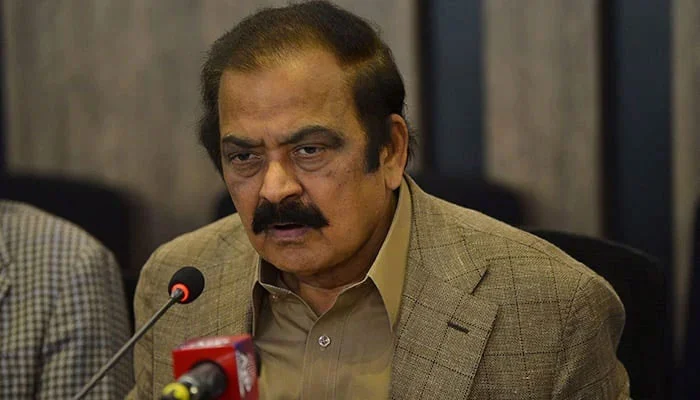
ISLAMABAD, May 17 (Alliance News): Adviser to the Prime Minister on Political and Public Affairs Rana Sanaullah has said that proposals linked to the possible 28th Constitutional Amendment are under discussion, including suggestions related to the voting age, governance reforms and resource distribution mechanisms.
Speaking during a television programme, Rana Sanaullah stated that one proposal under consideration involves revisiting the minimum age required for contesting elections in Pakistan.
He observed that if citizens are legally eligible to vote at the age of 18, then discussions could also take place regarding reducing the minimum age for contesting elections from 25 years to 18 years.
Under Pakistan’s current election laws, citizens aged 18 years or above are eligible to be registered as voters provided they meet residency requirements in the relevant electoral area.
During the discussion, the senior leader of the Pakistan Muslim League-Nawaz said consultations regarding the possible 28th Constitutional Amendment cover several important national policy matters.
According to him, the discussions include issues related to the National Finance Commission (NFC) award, population control measures, water resource management and the construction of new reservoirs.
Rana Sanaullah emphasized that the government would not proceed with any constitutional amendment without consensus among all major political stakeholders and provinces.
He stated that it was not necessarily required to alter the existing NFC formula and suggested that defence expenditures could potentially be addressed separately from the current provincial resource-sharing framework.
The adviser added that consultations on constitutional and governance matters have remained ongoing and would continue through broader political dialogue and parliamentary engagement.
The remarks come amid increasing political debate regarding reports of a possible 28th Constitutional Amendment ahead of Eid ul Adha, expected later this month.
Political circles have expressed concerns that any new amendment could potentially affect or dilute provisions of the landmark 18th Constitutional Amendment introduced during the Pakistan Peoples Party government in 2010.
The 18th Amendment significantly expanded provincial autonomy by devolving powers related to health, women’s development, social welfare and local government from the federal government to the provinces.
Over the years, debates have repeatedly emerged regarding possible reforms or revisions to certain aspects of the amendment, although the PPP has consistently opposed any attempt to weaken provincial powers.
Federal ministers, however, have dismissed speculation regarding immediate plans for a new constitutional amendment.
Federal Law Minister Azam Nazeer Tarar recently stated that any constitutional reform process would only move forward through broad-based political consensus and clarified that there were currently no clear indications of a formal 28th Amendment.
His statement aligned with comments made by PPP Chairman Bilawal Bhutto Zardari, who also denied that any formal talks had yet taken place regarding a proposed constitutional amendment.
Addressing a parliamentary party meeting, Bilawal Bhutto Zardari remarked that no discussions had officially begun regarding the 28th Amendment, although future political developments could not be ruled out.
Political analysts believe the ongoing discussions reflect broader national debates over governance reforms, federal-provincial relations and institutional restructuring in Pakistan.
Observers say any constitutional amendment would require extensive political negotiations due to the sensitivity of issues linked to provincial autonomy, electoral reforms and resource distribution.
Experts further note that achieving political consensus on constitutional reforms remains a major challenge in Pakistan’s complex parliamentary landscape.