 By Muhammad Mahdi
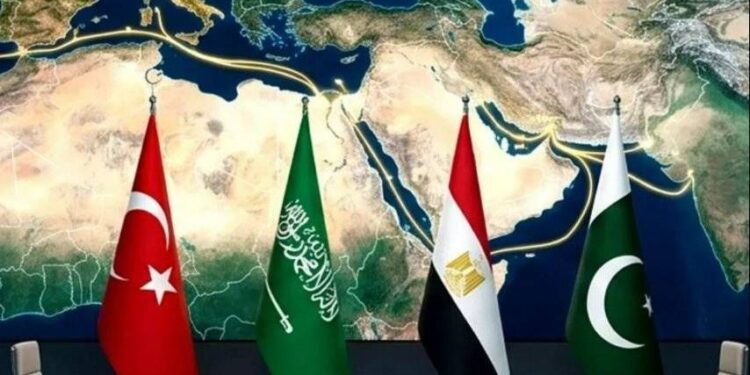
- The Middle East is currently on the precipice of a historic transformation, triggered by the military operations of the United States and Israel against Iran, which have fundamentally destabilized global geopolitical equilibriums. Within this critical juncture, the strategic alignment emerging between Saudi Arabia, Türkiye, Egypt, and Pakistan is redefining the regional security architecture.
Characterized as a “balancing power” against expansionist policies and threats to vital energy corridors, this alliance serves as a pragmatic defensive bloc focused on the preservation of regional territorial integrity.
The convergence of Pakistan’s nuclear deterrence and specialized manpower, Türkiye’s advanced defense industrial expertise, and Saudi Arabia’s substantial economic capabilities establishes a new center of resistance against the interventions of extra-regional actors.
In this context, we discuss the pivotal role of Islamabad as an interlocutor in the Iran-U.S. diplomatic channel and the emerging diplomatic equations of the region with one of Pakistan’s preeminent strategists, Muhammad Mehdi, Founder and Chairman of the Institute of International Relations and Media Research (IIRMR).
Mr. Mehdi provides comprehensive insights into the peace initiatives of Pakistan and Türkiye, the feasibility of formal defense pacts, and the strategic repositioning of Israel within the contemporary regional landscape.
What does a possible alliance among Egypt, Pakistan, Türkiye, and Saudi Arabia mean for the geopolitical landscape of the Middle East in the context of the Iran war?
It should be kept in mind that it would not be correct to describe the possible alliance of Pakistan, Türkiye, Egypt and Saudi Arabia as a Sunni alliance only.
The reason for this is that despite the Sunni majority population in Pakistan, Pakistan’s identity is completely non-sectarian due to its religious nature and there are people of the Sunni sect as well as the Shia sect at the highest levels in Pakistan.
An example of this can be given that the founder of Pakistan, Quaid-e-Azam Muhammad Ali Jinnah, was a Shia and even then, high-level officials of Pakistan, including the Interior Minister, are affiliated with the Shia sect.
Pakistan has the largest Shia population in the world after Iran and whenever any religious initiative is contemplated in Pakistan, whether it is related to local matters or international politics, this matter is definitely brought forward.
The Iran war has put the region in an unusual situation, but it is very important to look at the situation before this war. Israel was establishing political supremacy over the Arab world under the guise of the Abraham Accords, and if we look at the Gulf Arab countries, it is far from being possible for anyone except Saudi Arabia to resist, and it is not even worth resisting.
Saudi Arabia knows very well that even if it joins the Abraham Accords, Israel will not allow it to remain in the current situation, and it seems to be written on the wall that if the current government of Iran is overthrown and a government under the influence of Israel is established, it will be impossible for Saudi Arabia to remain safe either.
At this time, Saudi Arabia is a strategic depth for Iran and Iran for Saudi Arabia. Now, keeping this background in mind, the possible alliance of these four countries will have to be examined.
If this alliance is established, even if Iran is not formally included in it, it will definitely be a threat to Israel, and as the saying goes, the enemy of the enemy is also a friend.
Therefore, such an alliance will play an effective role against the desire of Israel and India to establish supremacy in the region and this will weaken Israel’s position with respect to the Gulf countries and Iran.
To what extent is such an alliance possible? What are the opportunities and challenges for such an alliance? In which areas could these countries cooperate?
The biggest challenge that these four countries will face will be from the other powers of the world, including the United States, from what point of view they view this alliance? What will be understood in this regard from Africa to Europe? Because the alliance of these four countries will reach the borders from Africa to Asia and Europe.
I see this possible alliance as a defensive or balancing alliance rather than an aggressive or expansionist one. And I think that in addition to the defense sector, maritime security, the protection of energy corridors, while achieving common goals in trade will be its main objectives.
What do the diplomatic efforts of Pakistan and Türkiye signify for the end of the Iran war?
Pakistan and Türkiye have completely stood by each other in this whole situation and the main reason why Pakistan was successful in holding the Islamabad talks is that it had the full support of a large and influential country like Türkiye.
Türkiye also showed immense patience and forbearance during this time and did not lose patience despite any air violation.
To what extent is a defense pact among Pakistan, Türkiye, and Saudi Arabia possible? How realistic would such a pact be?
There is a great possibility of a defense agreement between Pakistan, Saudi Arabia and Türkiye and this is completely feasible. Pakistan and Saudi Arabia have already signed a security package and now these three countries can sign a separate agreement.
This will have a huge impact not only on the region but also on the strategic situation of the entire world. Pakistan’s nuclear power as well as manpower, Türkiye’s expertise in other weapons manufacturing and Saudi Arabia’s defense budget of more or less seventy-five billion dollars, all of these together can create a very influential force.