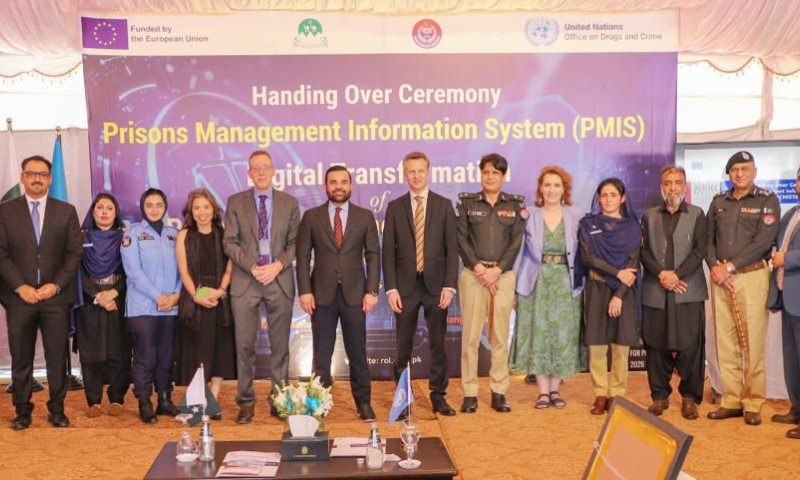
ISLAMABAD, May 16 (Alliance News): The United Nations Office on Drugs and Crime, with financial support from the European Union, formally handed over the Prison Management Information System (PMIS) to the Balochistan Prison Department during a high-level ceremony held in Islamabad, marking a major step toward modernising prison governance and strengthening justice sector reforms in Pakistan.
The newly introduced digital system will provide secure and centralized access to detainee and inmate records across 13 correctional facilities in Balochistan, including 11 prisons and the offices of the Inspector General and Deputy Inspector General of Prisons.
Officials said the PMIS would significantly improve coordination between prisons, courts and law enforcement agencies by enabling real-time data sharing and informed decision-making within the corrections sector.
The system is also expected to strengthen transparency, accountability and the protection of prisoner rights in accordance with international human rights standards, including the Nelson Mandela Rules.
The initiative has been introduced under the European Union-funded Deliver Justice Project, which has supported a wide range of justice sector reforms in Pakistan over the past five years.
Speaking at the ceremony, Head of Cooperation at the Delegation of the European Union to Pakistan, Jeroen Willems, said the PMIS represented another milestone in the EU’s broader efforts to support inclusive and citizen-centric justice reforms in Pakistan.
He noted that the Deliver Justice Project had contributed to strengthening institutional capacity and improving access to justice, particularly for women, vulnerable communities and underserved regions.
According to Willems, the initiative supported increased women’s representation in police forces, expanded legal aid services for women, and provided specialized human rights training to judges, prosecutors and police officials across the country.
He further highlighted the establishment of court-annexed mediation centres in different provinces aimed at improving dispute resolution mechanisms and reducing pressure on formal courts.
Reaffirming the European Union’s long-term commitment to justice reforms in Pakistan, Willems said digitalisation and institutional strengthening were essential for building transparent, accountable and efficient governance systems.
Officials noted that the PMIS would also directly benefit prisoners’ families through a digital visitor management mechanism aimed at improving transparency, reducing waiting times and facilitating safer prison visits.
The introduction of digital recordkeeping is expected to enhance prison administration, reduce documentation errors and strengthen public trust in correctional institutions through improved management and oversight.
Inspector General Prisons Balochistan, Abdul Saeed Naveed, said the PMIS had already demonstrated positive results in improving operational efficiency, coordination and record management within prison facilities across the province.
He stated that the system would help prison authorities streamline administrative processes, monitor inmate records more effectively and improve communication between different correctional institutions.
In his keynote address, UNODC Representative in Pakistan, Troels Vester, said the PMIS reflected a shared commitment to establishing transparent, modern and human rights-compliant prison management systems in Pakistan.
He said UNODC had provided extensive technical assistance, institutional support, technology transfer and capacity-building initiatives to ensure the long-term sustainability of the project.
According to Vester, these efforts included the establishment of a Prison Training Academy, an eLearning Centre in Mach and a Central Command Unit in Quetta to strengthen the professional capacity of prison officials and improve operational coordination.
He added that training materials, operational guidelines and policy frameworks had also been developed to support the effective functioning and maintenance of the digital system.
Officials further informed participants that the Government of Balochistan had allocated dedicated financial resources and trained personnel to ensure the continued operation and sustainability of the PMIS infrastructure.
Addressing the ceremony, Minister of State for Law and Justice, Aqeel Malik, emphasized the importance of digital reforms in strengthening Pakistan’s criminal justice system and improving governance outcomes.
He said the operationalisation of PMIS in Balochistan marked a significant achievement as all four provinces of Pakistan had now transitioned toward digital prison management systems.
The minister acknowledged UNODC’s longstanding partnership and technical support in implementing PMIS across Punjab, Sindh, Khyber Pakhtunkhwa and Balochistan.
He observed that technology-driven reforms could improve institutional efficiency, transparency and service delivery while ensuring better protection of human rights within correctional facilities.
The Deliver Justice Project, funded by the European Union with an investment of €20 million, is being implemented from 2021 to 2026 to strengthen Pakistan’s criminal justice institutions and improve access to justice, particularly in Balochistan and Khyber Pakhtunkhwa.
The project supports reforms in policing, prosecution, judiciary, prisons and legislative frameworks through institutional capacity building, digitalisation and governance reforms aimed at modernising Pakistan’s justice sector.
Experts believe the introduction of digital prison systems across the country could help improve prison oversight, streamline administrative procedures and ensure more transparent treatment of inmates in line with international standards.
The ceremony concluded with officials reaffirming their commitment to continued collaboration for strengthening Pakistan’s justice institutions through innovation, technology and inclusive governance reforms.