 https://twitter.com/home https://www.facebook.com/Shabbir.Hussain191
By Shabbir Hussain
ISLAMABAD, May 15 (Alliance News): Amid worsening smog, rising temperatures and mounting climate pressures, Pakistan is facing serious challenges in its energy sector, prompting experts and policymakers to call for an urgent shift toward cleaner, affordable and sustainable energy resources to secure the country’s economic and environmental future.
Energy experts, policymakers and environmentalists believe that Pakistan can no longer rely heavily on imported fossil fuels and expensive conventional energy systems when the country possesses enormous untapped potential in renewable resources such as solar, wind and hydropower.
They stressed that the country’s long-term sustainability depends on revisiting its national energy policy and adopting a modern, climate-responsive approach to energy production and consumption.
Experts argue that continued dependence on costly imported fuel has placed a severe burden on domestic consumers, industries and the national economy, while also increasing environmental degradation.
They termed the prevailing energy crisis a reflection of policy failures and lack of long-term planning by successive governments despite Pakistan being naturally endowed with abundant renewable energy resources.
According to analysts, affordable and clean energy has become essential not only for public welfare but also for the country’s economic survival.
The high cost of electricity and fuel has negatively affected industrial productivity, exports and business competitiveness, further widening Pakistan’s current account and trade deficits.
Environmental experts noted that shifting toward renewable energy sources could significantly help Pakistan reduce carbon emissions and mitigate the growing impacts of climate change.
They emphasized that decarbonization and reduced dependence on fossil fuels were no longer optional but necessary steps for the country’s sustainable development.
Pakistan, despite contributing minimally to global greenhouse gas emissions, remains among the world’s most climate-vulnerable countries.
Its geographical position between the rapidly industrializing economies of China and India has further intensified environmental pressures, particularly in the form of transboundary pollution and smog.
Renewable Energy expert, Dr Muhammad Zubair, while addressing a seminar on energy transition and climate resilience, said the future of renewable energy in Pakistan holds immense promise as the country simultaneously struggles to increase energy production and address the adverse effects of climate change.
He observed that Pakistan needed to move beyond traditional methods of energy generation and adopt modern technologies capable of ensuring environmental protection, social security and industrial sustainability.
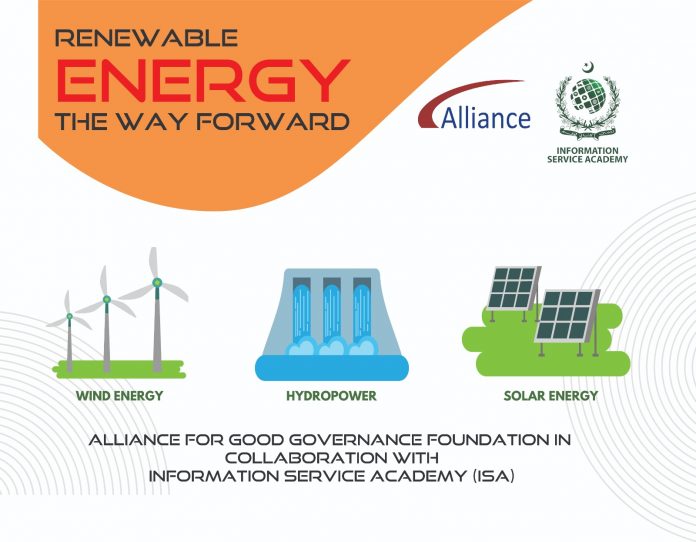
The seminar, jointly organized by the Information Service Academy and the Alliance for Good Governance Foundation, brought together policymakers, energy experts, environmentalists and academics to deliberate on the country’s energy transition challenges and opportunities.
Addressing participants, the Dr Muhammad Zubair highlighted that the concept of “just transition” required a balanced approach that protects vulnerable communities while moving toward cleaner energy systems.
He stressed that energy transition strategies must consider local realities, public ownership and inclusive participation at regional and national levels.
“We need to move away from greenhouse gas-intensive economic activities through financing, policy engagement, technical support and knowledge sharing according to our national priorities,” he said.
Dr Muhammad Zubair noted that the Energy Transition Mechanism was expected to become one of the key tools for implementing Just Energy Transition Partnerships, which serve as an umbrella framework for international cooperation and climate financing.
He expressed confidence that initiatives such as the Alternative Energy Development Board and supportive renewable energy policies could accelerate Pakistan’s transition toward clean and diversified energy systems.
According to Dr Muhammad Zubair, renewable energy diversification would strengthen Pakistan’s energy security while contributing to global efforts aimed at combating climate change and reducing carbon emissions.
He said that the government has already approved the National Electricity Plan 2023, which outlines implementation strategies and future policy guidelines for reforming the country’s power sector.
Officials believe the plan could help improve efficiency, reduce losses and encourage investment in renewable energy projects, he added.
Experts, however, warned that the worsening climate crisis is rapidly intensifying the urgency for action. Rising temperatures and accelerated glacier melting have triggered devastating floods, irregular rainfall patterns and water-related disasters across the country in recent years.
They argued that Pakistan has no choice but to adopt low-carbon development pathways and expand clean energy production to cope with increasing environmental and economic challenges.
Climate experts also stressed the importance of global cooperation, noting that Pakistan urgently requires financial and technical assistance from international partners and donor agencies to strengthen climate resilience and energy transformation efforts.
Managing Director of the Private Power and Infrastructure Board, Shah Jahan Mirza, warned that Pakistan could face even greater economic and environmental difficulties if it failed to prioritize clean energy and decarbonization.
“In this changing and competitive environment, clean energy must remain our top priority,” he observed, adding that the country had paid insufficient attention to renewable energy and decarbonization in the past.
He pointed out that renewable energy has become one of the most affordable energy options globally due to rapidly declining technology costs. Referring to international data, he noted that between 2010 and 2020, the cost of solar energy declined by nearly 85 percent, while offshore and marine wind energy costs fell substantially.
According to experts, these global trends offer Pakistan a significant opportunity to reduce energy generation costs and lessen dependence on imported fuel.
Environmental health concerns also emerged as a major topic during the discussion. Citing reports from the World Health Organization, speakers noted that a majority of the global population breathes polluted air exceeding recommended safety limits, while environmental pollution contributes to approximately 13 million deaths annually worldwide.
Former Chairman of National Electric Power Regulatory Authority, Dr. Irfan Yusuf, emphasized that renewable energy offers healthier, affordable and environmentally sustainable alternatives compared to conventional fossil fuel systems.
He stated that Pakistan’s existing energy model, which heavily relies on petroleum products and conventional biomass, continues to create negative socio-economic and environmental consequences.
Dr. Yusuf underlined that one of Pakistan’s biggest challenges is creating a stable and investor-friendly environment that allows renewable energy developers to assess and manage risks confidently.
He stressed the need for coordinated efforts to strengthen institutional capacity, technical expertise and public awareness regarding renewable energy technologies.
According to him, the transition toward clean energy cannot be achieved by the government alone and requires active support from the private sector, investors, financial institutions and development partners.
Energy analysts believe that encouraging renewable investors and simplifying regulatory frameworks could help accelerate clean energy projects and create new employment opportunities in Pakistan.
The country’s ongoing energy crisis, coupled with soaring electricity tariffs, has placed immense pressure on ordinary citizens and industrial sectors alike. Industries facing high production costs and unreliable power supply have struggled to remain competitive, resulting in reduced productivity and economic slowdown.
Experts warned that without urgent reforms and innovative policy measures, Pakistan could face prolonged economic instability and worsening environmental conditions.
They stressed that out-of-the-box solutions, long-term planning and political commitment are urgently needed to ensure affordable electricity, industrial growth and environmental sustainability.
Analysts further emphasized that renewable energy development should not only be viewed as an environmental necessity but also as a strategic economic opportunity capable of transforming Pakistan’s energy landscape, generating employment and reducing dependence on imported fuel.
They concluded that Pakistan stands at a critical crossroads where timely investment in clean and sustainable energy could help secure economic stability, environmental protection and energy security for future generations.