
 https://twitter.com/home https://www.facebook.com/Shabbir.Hussain191
By Shabbir Hussain
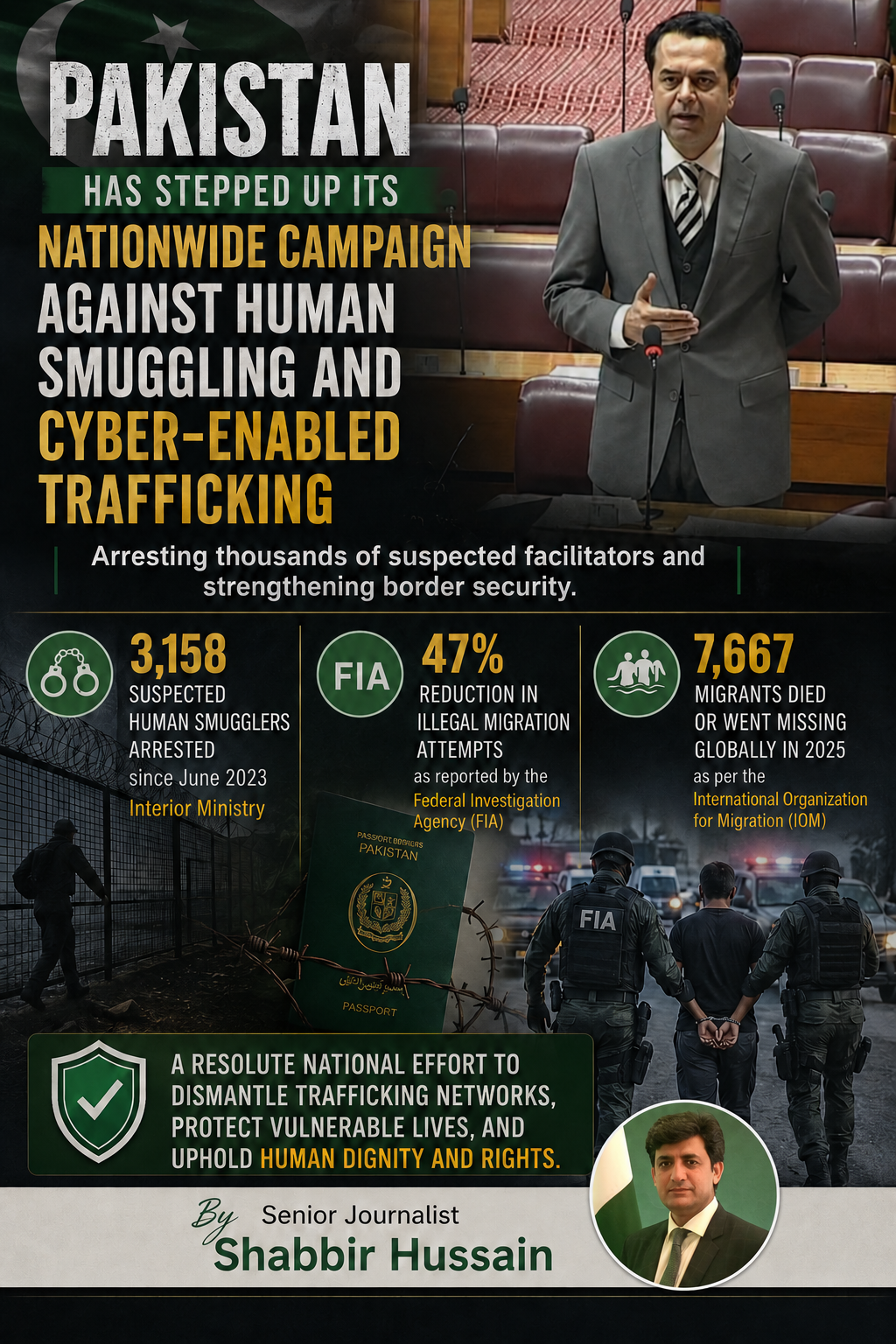
ISLAMABAD, May 22 (Alliance News): Pakistan has stepped up its nationwide campaign against human smuggling and cyber-enabled trafficking, arresting thousands of suspected facilitators and strengthening border security.
The government intensifies efforts to dismantle transnational criminal networks exploiting vulnerable citizens through illegal migration and fraudulent overseas job schemes.
The renewed crackdown comes as human trafficking evolves into one of the world’s fastest-growing transnational organized crimes, driven by poverty, unemployment, conflict, climate change and increasingly sophisticated online fraud schemes that lure victims with fake overseas job offers.
Speaking in the National Assembly on Friday, Minister of State for Interior and Narcotics Control Talal Chaudhry said the government was pursuing a zero-tolerance policy against illegal migration under the directions of Prime Minister Shehbaz Sharif.
He said law enforcement agencies had intensified operations against human smuggling networks operating both inside Pakistan and abroad, leading to a significant decline in illegal migration attempts and major disruptions to organized trafficking syndicates.
Responding to a calling attention notice regarding Pakistani nationals detained in Cambodia after being lured through fraudulent employment offers linked to cybercrime and online scam operations, the minister said authorities had arrested 3,158 agents involved in illegal migration since June 2023.
He added that assets worth millions of rupees had been seized and bank accounts containing substantial funds frozen to weaken the financial networks supporting traffickers.
Talal Chaudhry said the government had also taken strict action against officials found facilitating human smuggling. More than 100 officials of the Federal Investigation Agency (FIA) have faced departmental proceedings, criminal prosecution or convictions, while entire duty shifts were replaced in some instances to eliminate corruption and strengthen institutional accountability.
He said intelligence-based profiling, enhanced passenger screening and stricter monitoring at airports and border crossings had contributed to an estimated 47 percent reduction in illegal migration attempts.
The minister clarified that additional scrutiny of some travellers was aimed at identifying suspicious travel patterns linked to organized smuggling networks rather than creating inconvenience for legitimate passengers.
Highlighting the growing concern over trafficking routes to Cambodia, Talal Chaudhry said Pakistan had intensified investigations following a sharp increase in cases during 2024 and 2025 involving Pakistanis trapped in fake online recruitment schemes.
According to the minister, the FIA conducted 286 inquiries related to Cambodia, registered 111 criminal cases and prevented 222 passengers from travelling after they were identified through risk-based profiling.
He said around 15,000 Pakistanis are currently in Cambodia, many of whom were deceived by fraudulent online job advertisements promising lucrative employment opportunities.
Through diplomatic engagement, nearly US$1 million in fines imposed on 1,272 affected Pakistanis was waived, while authorities facilitated their return by issuing 631 emergency travel documents, 112 new passports and 75 renewed passports.
Four Pakistani nationals died in Cambodia, and their bodies were repatriated to Pakistan. He noted that traffickers often route victims through Thailand, Malaysia and Myanmar before reaching Cambodia, highlighting the increasingly sophisticated and transnational nature of these criminal enterprises.
The developments reflect a broader global crisis. According to the International Organization for Migration (IOM), at least 7,667 migrants died or went missing worldwide in 2025—an average of nearly 21 people every day.
The organization believes the actual figure is significantly higher because many deaths and disappearances remain unreported along remote land and sea migration routes.
Migration specialists say irregular migration is driven by a combination of poverty, unemployment, political instability, armed conflict, climate change, environmental disasters and limited access to education and economic opportunities.
Criminal groups exploit these vulnerabilities by offering fake overseas jobs, legal visas and safe travel arrangements before subjecting victims to forced labour, exploitation or human trafficking.
The United Nations Office on Drugs and Crime (UNODC) identifies economic hardship, insecurity and climate-related displacement among the leading drivers of irregular migration.
Many families sell land, jewellery or borrow heavily to finance overseas travel, making them particularly vulnerable to traffickers.
Although migrant smuggling and human trafficking are separate offences under international law, experts say the two crimes frequently overlap.
While smuggling generally involves facilitating illegal border crossings for financial gain, trafficking relies on force, deception or coercion to exploit victims through forced labour, sexual exploitation, domestic servitude, debt bondage and other forms of modern slavery.
One of the fastest-growing threats is cyber scam trafficking. Organized criminal networks increasingly use social media platforms, encrypted messaging applications and fake recruitment websites to advertise attractive jobs in customer service, information technology, digital marketing and casinos.
Upon arrival, victims are often stripped of their passports, confined in heavily guarded compounds and forced to operate investment fraud, cryptocurrency scams and romance scams targeting people across the world.
The United Nations estimates that cyber scam operations generate tens of billions of dollars annually, while trafficked workers frequently endure intimidation, physical abuse, torture and severe restrictions on their freedom.
Initially concentrated in Southeast Asia, these criminal networks have rapidly expanded into other regions, turning cyber-enabled trafficking into a growing global security challenge.
To strengthen its response, Pakistan has enacted the Prevention of Trafficking in Persons Act, 2018, and the Prevention of Smuggling of Migrants Act, 2018, providing law enforcement agencies with stronger legal powers to investigate traffickers, prosecute offenders and improve protection for victims.
The country has also adopted a National Action Plan on Human Trafficking and Migrant Smuggling, developed with technical assistance from the United Nations Office on Drugs and Crime (UNODC), focusing on prevention, prosecution, victim protection and international cooperation.
The FIA has expanded the role of its Anti-Human Trafficking and Smuggling Wing through intelligence-led investigations, stronger immigration controls under the Integrated Border Management System (IBMS), advanced forensic document examination, blacklisting of traffickers and closer cooperation with INTERPOL, IOM, UNODC and other international partners.
Pakistan has also launched its first Trafficking in Persons Hotline in partnership with the International Labour Organization (ILO), alongside nationwide awareness campaigns warning citizens about fake overseas employment offers, online recruitment fraud and the dangers of irregular migration.
Experts, however, caution that law enforcement alone cannot end human trafficking.
They emphasize that expanding employment opportunities, vocational training, education, legal migration pathways, regulation of overseas recruitment agencies, digital literacy and stronger international cooperation are equally essential to reducing the vulnerabilities exploited by organized criminal groups.
As poverty, conflict, climate change and economic uncertainty continue reshaping migration worldwide, experts say governments must adopt a comprehensive strategy that tackles both the criminal networks behind trafficking and the root causes forcing people into dangerous migration.