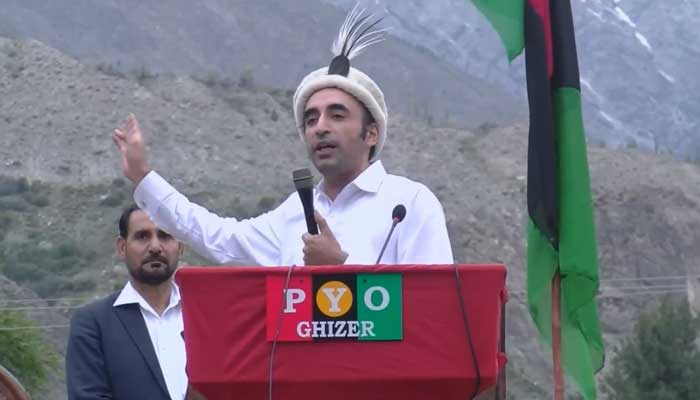
GHIZER, June 4 (Alliance News): Bilawal Bhutto Zardari on Thursday urged the people of Gilgit-Baltistan to grant the Pakistan Peoples Party (PPP) a clear mandate in the upcoming June 7 elections, saying a strong electoral victory was essential to secure land ownership rights and ensure the region’s voice is heard at the national level.
Addressing a public gathering in Ghizer as part of his election campaign, Bilawal said the people of Gilgit-Baltistan should elect a PPP government so that the party could effectively advocate for the region in Islamabad.
“A mandate is needed from Gilgit so that we can go to Islamabad and say that, before creating another province, the voice of Gilgit must be heard,” he told the gathering.
The PPP chairman stressed the need for a “jiyala” chief minister in Gilgit-Baltistan, arguing that only a PPP-led government could ensure land ownership rights for local residents. He said the party required a majority in the legislative assembly to enact the proposed ownership law.
Bilawal maintained that without a strong mandate, the PPP would face difficulties in passing legislation for Gilgit-Baltistan. He claimed that rival political parties, including the Pakistan Muslim League-Nawaz (PML-N), would oppose the party’s legislative agenda.
“It is necessary to form a PPP government so that the people here can obtain ownership rights. Cultivable land is currently divisible, and it must be made available to the people,” he added.
Gilgit-Baltistan is scheduled to hold elections on June 7 for its fourth Legislative Assembly. The region’s political framework was significantly shaped by the 2009 Gilgit-Baltistan (Empowerment and Self-Governance) Order, introduced during the presidency of Asif Ali Zardari, which aimed to provide greater autonomy and self-governance to the region.
According to election authorities, Gilgit-Baltistan has 963,034 registered voters, including 506,097 men and 456,937 women. The voter count represents a 29 percent increase compared to the 2020 elections. The gender gap between male and female voters has also narrowed to four percent from eight percent recorded in 2020.
Despite the significant rise in the number of registered voters, no new delimitation of constituencies has been carried out in the region since 1994. Election Commission sources have attributed the delay to the confidentiality surrounding census data for Gilgit-Baltistan.
The upcoming elections are being closely watched as political parties intensify campaigns across the region, seeking support on issues including governance, constitutional rights, development, and land ownership.