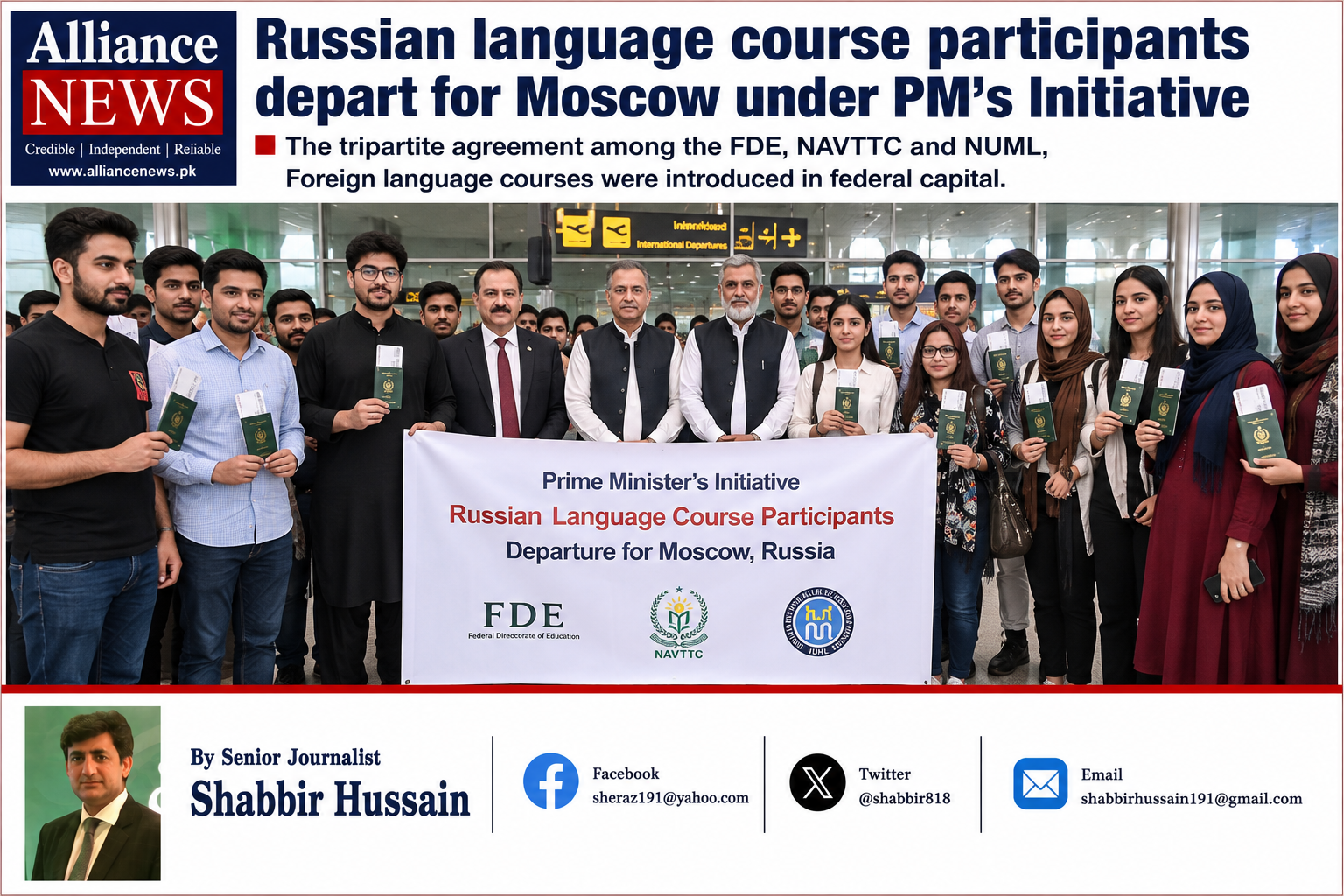
ISLAMABAD, Jul 25 (Alliance News): Ten students and two teachers who successfully completed a Russian language course under the Prime Minister’s Initiative departed for Moscow on Saturday for a two-week educational exposure visit, marking another milestone in the government’s efforts to equip Pakistani youth with internationally recognized language skills and global learning opportunities.
The visit has been arranged following the successful completion of the Russian Language Course at Islamabad Model College for Boys, I-8/3.
The participants are traveling to the Russian capital on the invitation of the Government of the Russian Federation as part of an educational exchange program aimed at strengthening academic cooperation and cultural understanding between Pakistan and Russia.
The initiative is being implemented under a tripartite agreement among the Federal Directorate of Education (FDE), the National Vocational and Technical Training Commission (NAVTTC) and the National University of Modern Languages (NUML).
Under the agreement, foreign language courses have been introduced in colleges operating under the FDE as part of the Prime Minister’s vision to prepare young Pakistanis for international education and employment opportunities.
Officials said the program reflects the government’s commitment to investing in human capital by providing students with practical language skills, international exposure and greater access to global academic and professional opportunities.
They added that foreign language education has become increasingly important in today’s interconnected world, where multilingual skills can significantly enhance career prospects and international collaboration.
The educational visit to Moscow will provide participants with first-hand exposure to Russian language, culture, educational institutions and academic practices.
During the two-week program, students and teachers are expected to interact with educational experts, participate in language learning activities and experience cultural exchanges designed to strengthen mutual understanding between the two countries.
Officials believe the experience will help participants improve their language proficiency while broadening their academic horizons and preparing them to compete in an increasingly globalized job market.
They said such initiatives also contribute to promoting people-to-people contacts and strengthening educational ties between Pakistan and the Russian Federation.
The introduction of foreign language courses under the Prime Minister’s Initiative is part of broader efforts to modernize Pakistan’s education and skills development framework.
Through collaboration between FDE, NAVTTC and NUML, students are being offered opportunities to learn internationally important languages that can open doors to higher education, research, trade and employment abroad.
Education experts have welcomed the initiative, saying language proficiency is becoming an essential skill in the modern economy.
They noted that exposure to different cultures and education systems helps students develop confidence, communication skills and a broader global perspective.
The Ministry expressed appreciation for the continued cooperation and support of the Federal Directorate of Education, NAVTTC, NUML and the Government of the Russian Federation in making the initiative a success.
Officials said the partnership demonstrates the value of collaboration among educational institutions and international partners in creating meaningful learning opportunities for Pakistani youth.
They also expressed hope that similar foreign language and international exchange programs would continue to expand in the future, enabling more students from across the country to benefit from quality education, cultural exchange and global networking opportunities.
The government reaffirmed its commitment to empowering young people through education, technical training and international engagement, describing such initiatives as important investments in Pakistan’s future workforce and its growing role in the global knowledge economy.